Every year, thousands of Indian professionals with 3–5 years of work experience ask the same question: "Is the ISB PGP actually worth it for someone like me?"
I asked myself the same thing before I joined. And the answer I found online was frustratingly generic: "The average CTC is ₹37 LPA, the programme costs ₹45 lakhs, the FT ranking is solid - go for it."
That's not an answer. That's a brochure.
The real question isn't whether ISB is worth it in the abstract. It's whether ISB is worth it for your specific profile, your industry, your career goals, and your financial situation. Having gone through the programme myself and now having helped dozens of professionals think through this decision at Acceptance Consulting, here's the honest breakdown nobody gives you.
The Numbers: What ISB PGP Actually Costs in 2026
Let's start with the full picture, not just tuition.
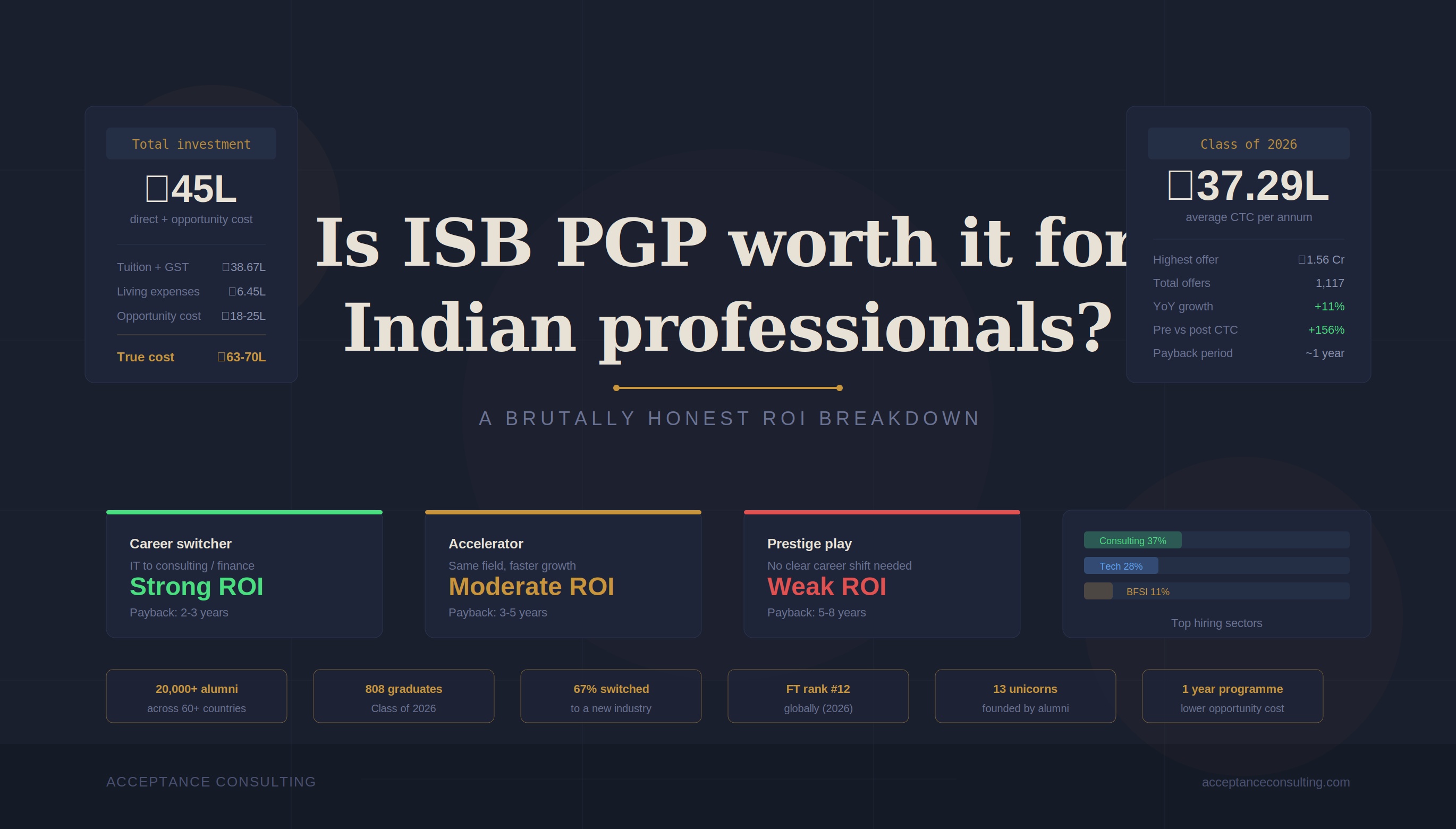
The programme fee for the 2026–27 intake is ₹38.67 lakhs (inclusive of GST, for shared accommodation). Add living expenses (books, laptop, meals, personal costs) and you're looking at roughly ₹6.45 lakhs more. That brings your direct cost to approximately ₹45 lakhs.
But direct cost is only half the story. The real cost of ISB is the opportunity cost: one full year of salary you're giving up. If you're earning ₹18–25 LPA pre-MBA (which is typical for the 3–5 year work-ex cohort), your total economic cost is closer to ₹63–70 lakhs.
That's the number you should be running your ROI calculation against — not ₹38 lakhs.
The Placement Reality: Beyond the Average
The Class of 2026 graduated 808 students, received 1,117 job offers, and posted an average CTC of ₹37.29 LPA — an 11% jump from the previous year. The highest offer was ₹1.56 crore.
Impressive headlines. But averages hide more than they reveal. Here's what actually matters.
By Industry
Consulting and professional services accounted for 37% of all offers. Technology took 28%. BFSI came in at 11%. FMCG, retail, and e-commerce made up about 5%. The remaining 19% was spread across conglomerates, manufacturing, healthcare, energy, media, and the social sector.
What this means for you: if you're targeting consulting or tech, the two sectors that absorb nearly two-thirds of the batch, the placement odds are strongly in your favor. If you're targeting a niche sector like healthcare strategy or clean energy, you need to go in with eyes open. Those opportunities exist, but the pipeline is thinner, and you'll likely need to do more independent networking.
By Career Switch vs. Continuation
This is where ISB genuinely shines. The Class of 2026 data shows 67% of graduates moved to a new industry and 69% shifted to a new function. That's not a small number. ISB is, at its core, a career-switching machine.
If you're an engineer wanting to break into consulting, a CA wanting to move into product management, or a sales professional aiming for strategy — that's exactly what the programme is built for. If you're already in your target industry and function and just want a salary bump, the ROI calculation changes.
By Work Experience
The sweet spot for ISB is 4-6 years of work experience. The average for the Class of 2025 was 4.1 years. If you're in this range, you fit the cohort profile, and recruiters are expecting candidates at your level.
Here's the nuance: if you're at 2-3 years, you'll be competing with peers who have more experience, and some recruiters filter by years of work-ex for senior roles. If you're at 8-10 years, you might find that the roles offered on campus don't match the seniority you've already achieved. In that range, the PGP PRO or PGP MAX may be worth a look.
The ROI Framework: Three Ways to Think About It
Scenario 1: The Career Switcher (Strong ROI)
Pre-ISB: Software engineer at a mid-tier IT company, earning ₹14 LPA after 4 years.
Post-ISB: Management consulting role at a Big 4 or MBB, starting at ₹28–45 LPA.
Total cost (including opportunity cost): ~₹59 lakhs. Salary jump: ₹14–31 LPA per year. Payback period: 2–3 years.
This is the profile where ISB delivers the clearest financial ROI. You're not just getting a salary bump, you're fundamentally repositioning your career trajectory. The compounding effect of starting at ₹35+ LPA and growing at consulting-level rates means the five-year earnings difference is enormous.
Scenario 2: The Accelerator (Moderate ROI)
Pre-ISB: FMCG brand manager earning ₹22 LPA after 5 years.
Post-ISB: Senior brand role or strategy role at ₹30–38 LPA.
Total cost: ~₹67 lakhs. Salary jump: ₹8–16 LPA per year. Payback period: 3–5 years.
The financial ROI is positive but less dramatic. The real value here is acceleration, you might have reached ₹35 LPA eventually, but ISB compresses that timeline by 3–4 years and gives you access to a different tier of companies and roles. The alumni network and the "ISB on your resume" signal also compound over a decade.
Scenario 3: The Prestige Play (Questionable ROI)
Pre-ISB: Already earning ₹30 LPA in a role you enjoy, at a company you like.
Post-ISB: Lateral move to a similar function at ₹35–40 LPA.
Total cost: ~₹75 lakhs. Salary jump: ₹5–10 LPA per year. Payback period: 5–8 years.
If the primary motivation is "I want an ISB tag" or "my friends are doing an MBA," the financial ROI doesn't justify the investment for most people. The programme is transformative, but transformation only matters if you need it.
What ISB Gives You Beyond a Salary
The ROI calculation above is purely financial, and it misses some things that genuinely matter.
Network. ISB's alumni network now spans over 20,000 professionals across 60+ countries — including 800+ C-suite leaders, 1,200+ entrepreneurs, and founders behind 13 unicorns. The one-year format means your batch bonds intensely. I still get WhatsApp messages from batchmates when I need an introduction to a company or a perspective on a deal. This isn't a passive alumni directory. It's a working network where a single message can get you a warm intro to a partner at McKinsey, a product lead at Google, or a VC evaluating your startup. This compounds in value over 10–20 years in ways that are impossible to quantify at admission time — but talk to any ISB alum five years out, and the network is usually the first thing they mention.
Optionality. Before ISB, most professionals have one career path. After ISB, you have three or four. Even if you don't switch immediately, knowing that you could pivot to consulting, product, VC, or entrepreneurship gives you leverage and confidence in every career negotiation.
Confidence and frameworks. This sounds soft, but it's real. After a year of case competitions, live projects, and peer learning with 800 driven professionals, you approach business problems differently. You have vocabulary and frameworks that make you more effective in any role.
International exposure. The Class of 2026 saw 30 international offers, up from 26 the year before. ISB's partnerships with Wharton, Kellogg, and LBS create exchange and immersion opportunities. For professionals who want a global career, ISB is a credible launchpad though not as strong as studying abroad directly.
When ISB PGP Is NOT Worth It
I'd be doing you a disservice if I only talked about when ISB works. Here are the situations where I actively advise clients against it and I say this as someone who loved the programme.
When the math genuinely doesn't work for your financial situation. Let me be specific. A ₹45 lakh education loan at 9–10% interest over 7 years means EMIs of roughly ₹45,000–55,000 per month. If your post-ISB salary is ₹30–35 LPA (which is around the average), your monthly in-hand is approximately ₹1.8–2.2 lakhs. After EMI, rent in a city like Bangalore or Mumbai (₹60,000–85,000), and basic living costs, you'll be financially tight for 3–4 years. If you're also supporting family, have existing loans, or don't have savings to cushion the transition, the financial stress can undermine the very career confidence the MBA was supposed to give you. Do the loan math honestly before you apply, not after.
When you're from a family business background and will return to it immediately. ISB's placement machine is optimised for corporate recruiting. If your plan is to go back to your family's manufacturing or trading business within six months of graduation, you're paying ₹45 lakhs for a credential and network that could be built differently. Consider ISB's PGP MFAB (Management for Family Business) instead, it's specifically designed for your situation and includes a curriculum around succession planning, governance, and scaling family enterprises.
When you're targeting entrepreneurship right out of campus. ISB has 1,200+ alumni entrepreneurs and a growing startup ecosystem, which is impressive. But the honest reality is that campus culture, peer pressure, and the weight of a ₹45 lakh loan push most graduates toward corporate jobs. If you're genuinely going to start a company immediately after graduating, the programme fee is seed capital you're diverting away from your venture. The network benefit is real, but it can be accessed through ISB's ivi or executive education at a fraction of the cost.
When you have 0–2 years of experience. The ISB PGP requires a minimum of 24 months of full-time work experience. If you're a final-year student or early in your career with less than two years of experience, the PGP isn't an option for you and that's by design. What you should look at instead is the ISB PGP YL (Young Leaders) programme, which has replaced the older YLP. The PGP YL is a 20-month full-time residential programme specifically designed for high-potential individuals with 0-24 months of work experience. It accepts GMAT, GRE, and CAT scores, and the curriculum is tailored to build business fundamentals from the ground up rather than assuming mid-career context. If you're a final-year student reading this and thinking "ISB sounds right for me," PGP YL is your pathway, not the flagship PGP. Additionally, if you have a strong CAT score (99th percentile+), 0–2 years of experience, and you're not sure exactly what function or industry you want to target, a two-year programme at an IIM or at ISB gives you more time to explore, more summer internship opportunities to test-drive careers, and a lower total cost.
When you're doing it because everyone else is. This is the one that pains me the most. MBA admission has become a social milestone in certain Indian professional circles - the way an engineering degree was a decade ago. "My manager did it, my college friends are applying, my parents want me to." If the strongest reason you can articulate for ISB is external validation, save yourself ₹45 lakhs and the emotional labour of the application process. ISB is transformative for people who need transformation. For everyone else, it's an expensive year in Hyderabad or Mohali.
The Bottom Line
ISB PGP is worth it for Indian professionals who meet three conditions: you want a meaningful career change or acceleration, you have 4–6 years of experience that gives you something to build on, and you've done the honest math on both the financial and opportunity cost.
It's not worth it as a default life choice, a prestige play, or a "figure it out later" decision.
The professionals who get the most out of ISB are the ones who walk in with a clear story - why this programme, why now, and what comes after. That clarity doesn't just help you get admitted. It helps you get placed, and it shapes whether the ₹45 lakhs was the best investment of your life or an expensive detour.
At Acceptance Consulting, Tanya and I help Indian professionals think through exactly this decision — and if ISB is the right move, we help them put together applications that get results. We're both ISB PGP alumni, and between our applicant community of 1,000+ members, we've seen every profile variation and outcome. If you're weighing whether ISB is right for you, we'd love to chat.
By Manan Gupta