
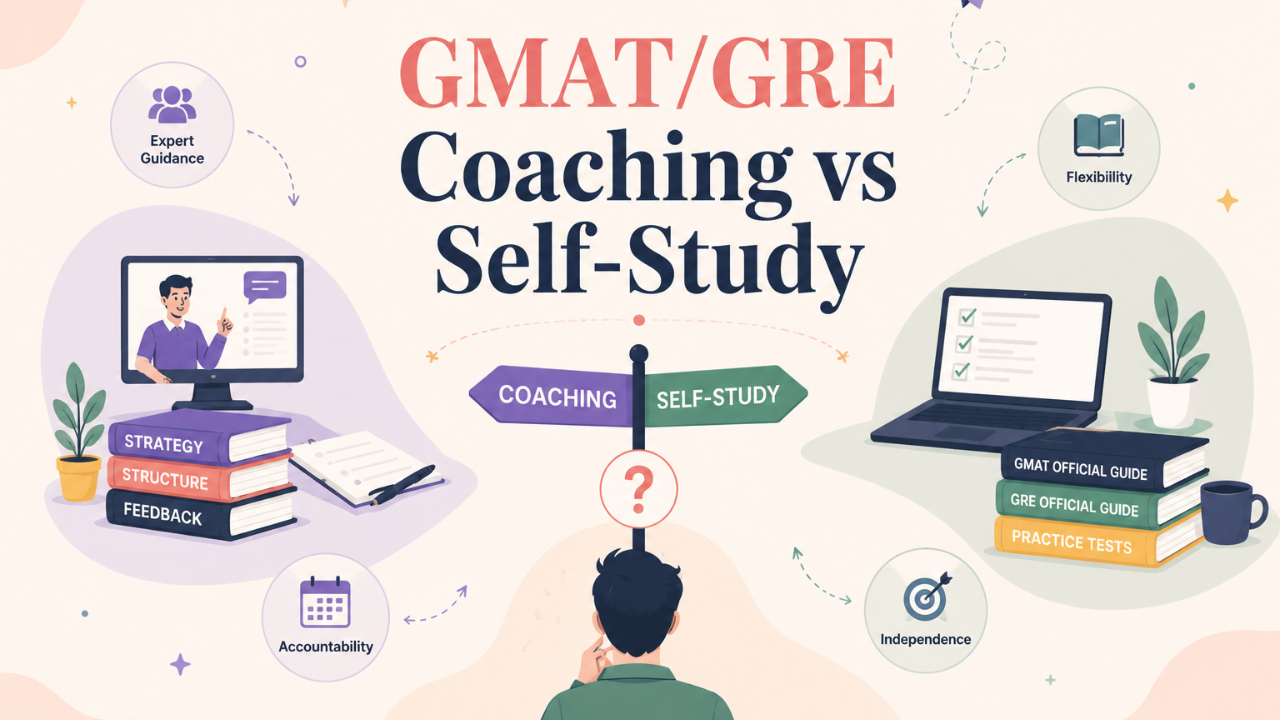
If you're planning to apply for an MBA, chances are you've asked yourself this question:
"Do I really need coaching for the GMAT or GRE, or can I prepare on my own?"
There isn't a universal answer.
We've seen applicants score 745+ through self-study. We've also seen candidates make significant jumps from the low 500s to 700+ after joining a structured coaching program.
The real question isn't which method is better. It's which method is better for you.
Before you spend thousands on a coaching course or convince yourself that YouTube videos are enough, it's worth taking an honest look at your learning style, timeline, and starting point.
First, be brutally honest with yourself.
The choice between self-study and coaching often comes down to discipline and accountability.
Self-study gives you flexibility, while coaching gives you accountability. Some people are great at sticking to a study plan on their own, while others need the structure of regular classes and deadlines to stay consistent.
Neither approach is better than the other. What matters is being realistic about which one suits you.
Self-study works really well... for the right person.
If you've always been comfortable learning on your own, you may not need a classroom at all. The official GMAT and GRE resources, along with a few good mock tests and practice questions, are often enough to build a strong preparation plan.
The tricky part isn't finding study material—it's figuring out why you're getting questions wrong. Many students spend hours practicing but keep repeating the same mistakes without realizing it. That's usually when progress slows down and preparation starts to feel frustrating.
So what does coaching actually give you?
Let's clear up one misconception: you're not paying someone to explain percentages or grammar rules. You can learn those online.
What good coaching really gives you is perspective.
A good instructor can look at one mock test and say,
“You're spending too much time on medium-difficulty questions."
Or,
"You're overthinking Reading Comprehension passages."
Or even,
"You're trying to solve every question. That's the problem."
Sometimes one conversation saves weeks of trial and error. That's the real value.
Not the lectures. The feedback.
Don't let other people's preparation decide yours.
One of your friends joins coaching and scores 705.
Another studies independently and scores 745.
Neither story has anything to do with you.
Everyone starts from a different place.
Some applicants need to rebuild school-level maths after years of working.
Others just need to improve verbal reasoning.
Some have four months before Round 1 deadlines. Others have barely eight weeks.
The right preparation strategy depends on your starting point, not someone else's success story.
If you're still unsure, here's what we'd suggest.
Don't rush into an expensive coaching program on Day 1.
Spend the next three to four weeks preparing on your own and do it consistently. Not just when you happen to have free time, but as part of a routine you can stick to.
As you study, track your mock scores, review your mistakes carefully, and pay attention to whether you're making steady progress.
If your scores continue to improve, that's a sign your current approach is working. But if you've genuinely put in the effort and your performance has plateaued, it may be time to bring in a coach.
The advantage of waiting is that you'll have a much clearer understanding of your strengths, weaknesses, and the specific areas where you need support. That makes any coaching you invest in far more effective.
So... coaching or self-study?
If we had to pick just one answer, we'd say this:
Don't choose a method because everyone else is doing it.
Choose the one that gives you the best chance of staying consistent.
We've seen people spend ₹60,000 on coaching and barely improve because they expected the classes to do the work for them.
We've also seen applicants achieve exceptional scores with nothing more than official study material, a spreadsheet to track mistakes and the discipline to show up every day.
Neither approach is inherently better.
The best one is the one you'll actually stick with.
Because at the end of the day, admissions committees won't know whether you studied in a classroom, at your dining table or during your commute to work.
They'll only see one thing.
Your score.