

Neither the GRE nor the GMAT is universally easier or better for MBA admissions. Choose an exam your target programmes accept, then compare your performance on current official practice tests. The GRE includes an essay and vocabulary-in-context questions; the GMAT includes a separate Data Insights section and no essay.
Start with the school, not the test's reputation. Requirements can differ between programmes at the same institution. ETS lists MBA programmes that accept the GRE and advises applicants to check each school's requirements directly.
GRE vs GMAT: Current Format, Timing and Scores
The comparison below covers the current GRE General Test and GMAT, using standard timings. Approved accommodations may differ. On a small screen, scroll the table sideways to read all columns.
| Feature | GRE General Test | GMAT |
|---|---|---|
| Total testing time and questions | About 1 hour 58 minutes; 54 Verbal and Quantitative questions, plus one writing task. | 2 hours 15 minutes; 64 questions, plus one optional 10-minute break. |
| Verbal Reasoning | 27 questions across two sections: 12 in 18 minutes, then 15 in 23 minutes. | 23 questions in 45 minutes. |
| Quantitative Reasoning | 27 questions across two sections: 12 in 21 minutes, then 15 in 26 minutes. | 21 questions in 45 minutes. |
| Writing | One 30-minute Analytical Writing task: Analyze an Issue. | No essay section. |
| Data Insights | No separate section; data analysis is included in Quantitative Reasoning. | 20 questions in 45 minutes. |
| Reported score scales | Verbal and Quantitative: 130–170 each, in 1-point steps. Analytical Writing: 0–6, in half-point steps. ETS reports these separately. | Total: 205–805, in 10-point steps. Each section: 60–90, in 1-point steps. The three sections have equal weight in the total. |
| Calculator | On-screen calculator in Quantitative Reasoning. | On-screen calculator in Data Insights only; none in Quantitative Reasoning. |
| Navigation and answer changes | Skip, return to and change answers within the current section while time remains. | After answering every question in a section, review questions and change up to three answers if time remains. |
| Section order | Writing first; Verbal and Quantitative sections can follow in different orders. | Choose the order of the three sections. |
Official sources for the table: ETS test structure and navigation, ETS score scales, GMAC exam structure and navigation, GMAC score scales, and GMAC section content and calculator rules.
What Do the GRE and GMAT Test?
Verbal reasoning: vocabulary in context or argument analysis?
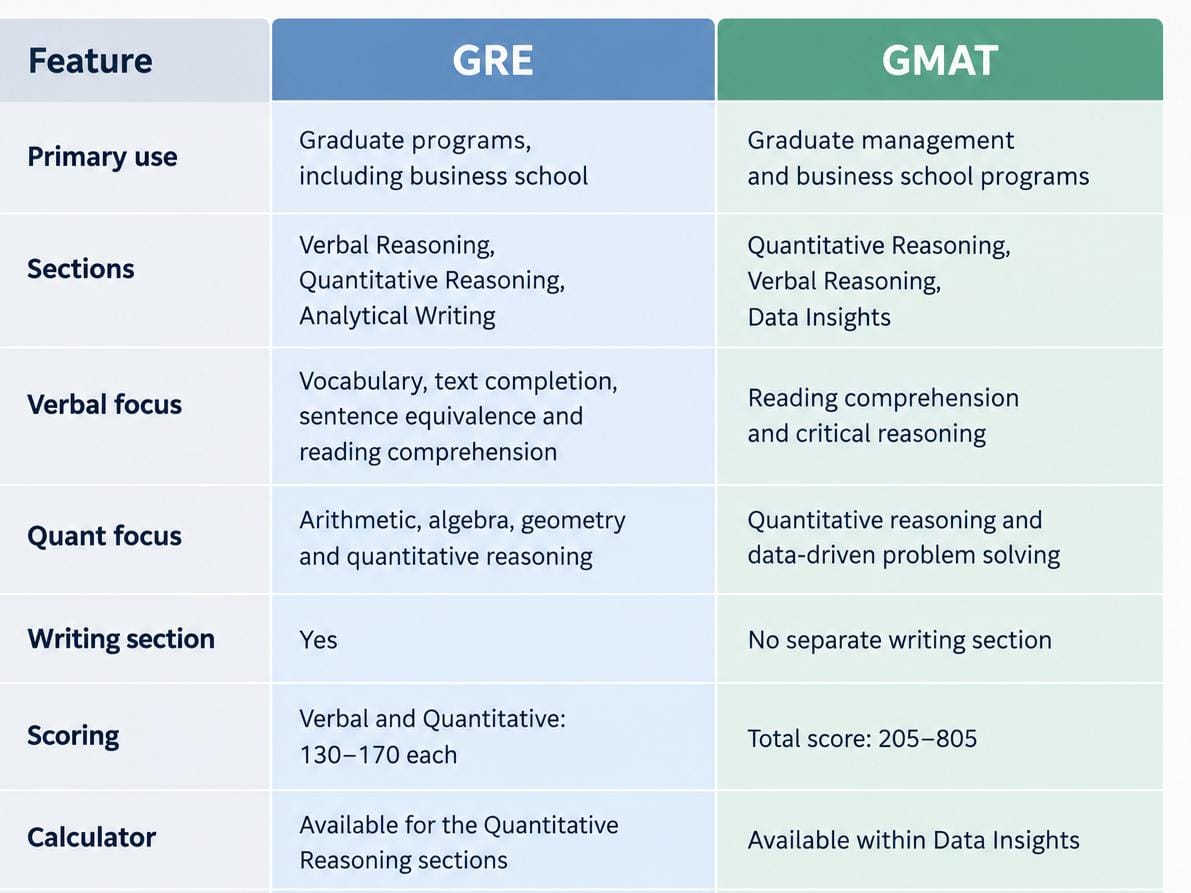
The GRE uses Reading Comprehension, Text Completion and Sentence Equivalence. Vocabulary matters, but understanding the sentence or passage matters too. GMAT Verbal uses Reading Comprehension and Critical Reasoning, including questions about how arguments work. Both require careful reading and reasoning. Compare the official GRE Verbal question types and GMAT content guide before judging either from a few sample questions.
Quantitative reasoning and data
GRE Quantitative Reasoning covers arithmetic, algebra, geometry and data analysis. GMAT Quantitative Reasoning uses Problem Solving questions based on arithmetic and elementary algebra. Its separate Data Insights section includes Data Sufficiency, Multi-Source Reasoning, Table Analysis, Graphics Interpretation and Two-Part Analysis, as described in GMAC's section guide.
Being comfortable with maths does not settle the choice. Test how you handle unfamiliar wording, data presented in different forms, calculator restrictions and the time available.
Is the GRE Easier Than the GMAT?
There is no reliable one-size-fits-all answer. A shorter exam or access to a calculator does not automatically make a target score easier to achieve. Likewise, avoiding an essay does not tell you how you will perform on Data Insights.
Use your mistakes as evidence. Are you losing time on vocabulary, algebra, dense reading or interpreting several sources of data? Separate gaps in knowledge from pacing and unfamiliarity with the interface. Those observations are more useful than choosing a test because a friend found it easier.
How to Choose in Five Steps
- Check every target programme. Record accepted tests, any stated preference, score-validity requirements and submission deadlines from the current admissions pages. Check non-MBA programmes separately if they are also on your list.
- Learn both formats before testing yourself. Work through official sample questions and navigation tools so that unfamiliar buttons or question types do not dominate your first result.
- Take one timed official practice test for each. Use ETS POWERPREP, selecting a timed option, and a GMAT Official Practice Exam. Follow each exam's timing and calculator rules in a quiet setting.
- Compare section-level results and the work ahead. Review accuracy, unanswered questions, time pressure and recurring errors. Use your schools' published class profiles as context, not admission cut-offs. Do not treat a GRE number, a GMAT number or matching percentiles as interchangeable measures of admission chances.
- Choose a plan you can sustain. Allow time for study, score reporting and a possible retake before your application deadlines. If you need help deciding how to prepare, our guide to coaching versus self-study discusses the practical trade-offs.
GRE vs GMAT: Common Questions
Can I add my GRE Verbal and Quantitative scores to compare with the GMAT?
You can calculate a sum, but ETS reports Verbal, Quantitative and Analytical Writing separately. A combined GRE figure is not an official equivalent of a GMAT total. Check which scores and exam versions a school uses in its published profile rather than inventing a conversion.
Should I take both exams?
Our recommendation is to try official practice for both before committing, not automatically pay to sit both. If one accepted test fits your preparation needs, focus there. Reconsider only when your target programmes' requirements or evidence from your preparation gives you a reason to switch.
Fit Your Test Choice Into Your MBA Plan
Your test choice should support the programmes you actually want to attend. If you are still shaping that list or balancing testing with the rest of your application, explore our ISB and Indian MBA admissions support or international MBA admissions support.
Exam details checked against ETS and GMAC guidance on 18 October 2026. Confirm current exam and programme requirements before booking.